
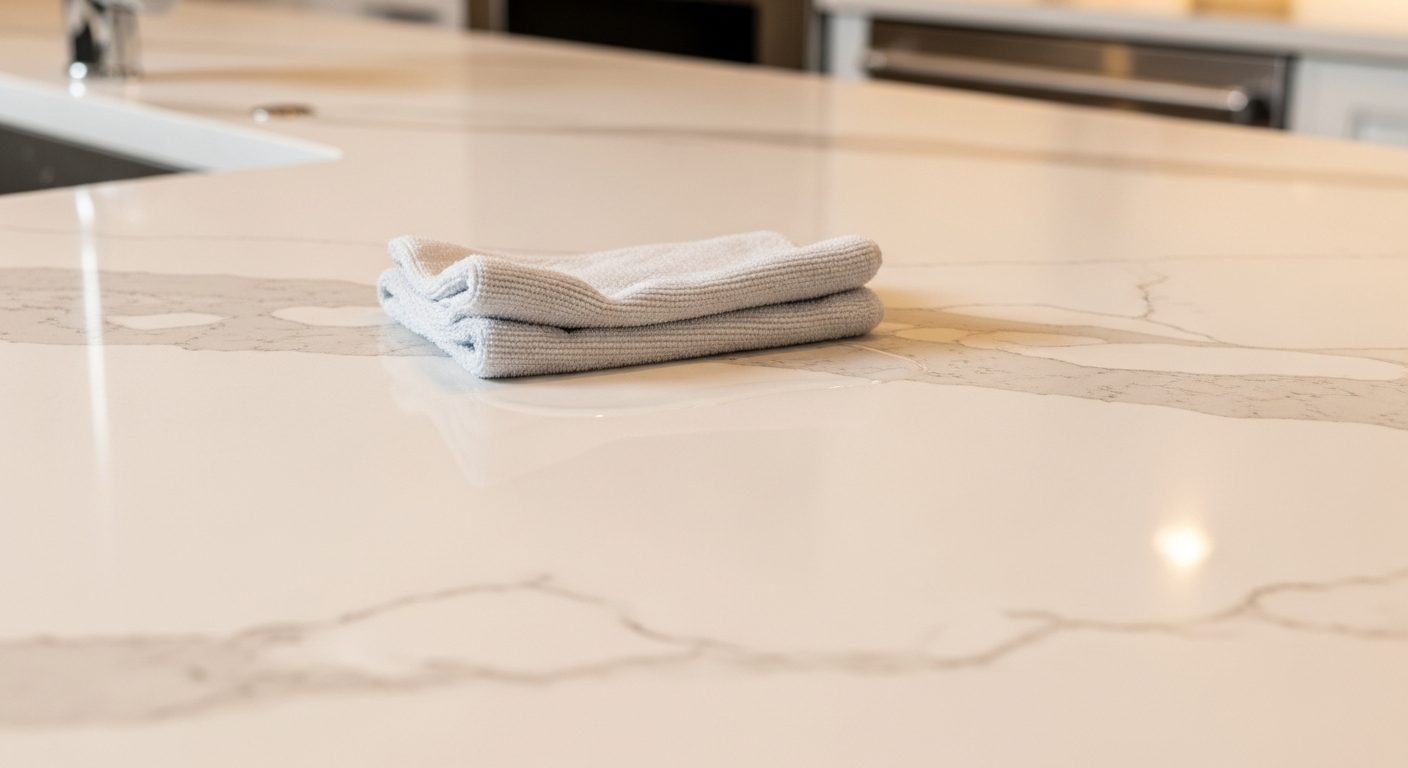
Quartz countertops have become one of the most popular choices for kitchens and bathrooms across the Kitchener-Waterloo region, and it's easy to understand why. They're beautiful, durable, non-porous, and available in a stunning range of colours and patterns. But even though quartz is considered low-maintenance, "low" doesn't mean "no" maintenance.
Proper quartz countertop care ensures your surfaces stay looking like new for decades. This guide covers everything you need to know about daily cleaning, stain prevention, heat protection, and long-term maintenance for your quartz countertops.
Before diving into care instructions, it helps to understand what you're working with. Engineered quartz countertops are made from roughly 90 to 94 percent ground natural quartz crystals bound together with polymer resins, pigments, and sometimes recycled materials. This manufacturing process creates a surface that's harder and more consistent than most natural stones.
The resin binders are what make quartz non-porous—unlike granite or marble, quartz doesn't need sealing and won't absorb liquids the way natural stone can. However, those same resins are what make quartz vulnerable to excessive heat and certain chemicals, which we'll cover in detail below.
The good news is that everyday quartz countertop care is remarkably simple. For routine cleaning, you only need a few basic supplies.
For everyday spills and crumbs, here's what works best:
That's genuinely all you need for daily maintenance. Quartz's non-porous surface means that most spills sit on top of the material rather than soaking in, so a quick wipe-down handles the vast majority of messes.
If you prefer a dedicated countertop cleaner rather than dish soap and water, look for products that are specifically formulated for quartz or engineered stone. These cleaners are pH-balanced and won't damage the resin binders.
A simple homemade cleaning solution that works well: mix one part white vinegar with three parts warm water in a spray bottle. Spray, wipe, and dry. This cuts through grease and leaves a streak-free finish. However, avoid using undiluted vinegar, as the higher acidity can dull the surface over time.
Certain cleaning products can damage quartz countertops by attacking the resin binders or dulling the surface finish. Avoid these:
While quartz resists staining far better than natural stone, stubborn messes can occasionally occur. Here's how to handle the most common ones.
For food that's dried onto the surface, don't reach for an abrasive pad. Instead:
If ink, permanent marker, or food dye stains your quartz surface, use isopropyl rubbing alcohol on a soft cloth. Apply the alcohol to the cloth (not directly to the countertop), rub gently, and then clean the area with soap and water to remove any alcohol residue.
Hard water is a fact of life in much of the Kitchener-Waterloo region, and mineral deposits can build up on countertop surfaces, particularly around sinks. To remove hard water stains:
To prevent hard water buildup, make a habit of wiping your countertops dry after cleaning, especially around the sink area.
Quartz resists these common kitchen stains much better than granite or marble, but if a spill is left sitting for an extended period, some discolouration can occur. Clean these spills as soon as possible with warm water and dish soap. For stubborn marks, the baking soda paste method works well.
This is perhaps the most important aspect of quartz countertop care that homeowners need to understand. While quartz is extremely hard and scratch-resistant, the resin binders in engineered quartz are sensitive to heat. Excessive heat can cause the resins to crack, discolour, or warp, resulting in permanent damage that's difficult or impossible to repair.
A good rule of thumb: if it's hot enough that you wouldn't hold it in your bare hand, don't set it directly on your quartz countertop.
Quartz is one of the hardest countertop materials available, scoring a 7 on the Mohs hardness scale. That said, it's not indestructible. Here are some habits that will keep your surface scratch-free.
While quartz won't scratch from a kitchen knife under normal use, cutting directly on the surface will dull your knives quickly and can eventually cause fine scratches that accumulate over time. Always use a cutting board—your knives and your countertops will both benefit.
Dropping heavy objects like cast iron pans, ceramic dishes, or canned goods onto quartz can chip the edges or crack the surface. Be particularly careful around the edges of the countertop and near the sink cutout, as these areas are more vulnerable to impact damage.
Dragging heavy appliances, ceramic pots, or rough-bottomed items across the countertop can leave scratches. Lift items rather than sliding them, or place felt pads under appliances that sit permanently on the counter.
One care consideration that many homeowners overlook is sun exposure. Prolonged direct sunlight can cause some quartz colours to fade or yellow over time, particularly lighter shades. The UV rays break down the resin binders and pigments, leading to gradual discolouration.
If your kitchen has large windows that allow direct sunlight to hit the countertops for extended periods, consider:
Beyond daily cleaning, these habits will keep your quartz countertops looking pristine for years to come.
Once a month, give your countertops a thorough deep clean:
If your countertop installation includes seams, keep the seam areas clean and dry. While the seams are filled with colour-matched adhesive, moisture that sits in seams over time can occasionally cause discolouration. Wipe seams dry after cleaning and avoid letting standing water collect along them.
Unlike granite and marble, quartz countertops never need sealing. The non-porous surface means there are no microscopic pores for liquids or bacteria to penetrate. If someone tries to sell you a quartz sealer, you don't need it—and applying one could actually leave a residue that's difficult to remove.
Despite your best care efforts, accidents happen. Here's what to do if your quartz surface sustains damage.
Small chips, particularly along edges, can often be repaired with a quartz or engineered stone repair kit that includes colour-matched adhesive. For the best results, have a professional handle the repair to ensure a seamless colour match.
Cracks in quartz usually require professional assessment and repair. A qualified stone fabricator can fill cracks with colour-matched epoxy, though the repair may be visible depending on the severity and location.
Unfortunately, heat damage to quartz is usually permanent. Discolouration or warping caused by excessive heat cannot typically be polished or buffed out the way scratches can on natural stone. This is why heat prevention is so critical.
If your quartz has lost its shine due to harsh cleaners or buildup, a professional stone restoration company can often polish the surface back to its original finish. Switching to proper cleaning products will prevent the issue from recurring.
Let's clear up some common misconceptions about quartz countertop care:
Proper care keeps your quartz countertops looking beautiful for the lifetime of your kitchen. If you're considering quartz for a new kitchen or bathroom project, or if you have questions about caring for your existing surfaces, our team at Kitchen & Bath World is always happy to help.
Visit our showroom at 899 Victoria St N in Kitchener to see our full selection of stone and quartz countertop options, or contact us to discuss your project. Call us at (519) 744-2284—we serve homeowners throughout Kitchener, Waterloo, Cambridge, and Guelph.
Answers to your renovation questions
No. Never set a hot pan, pot, or baking sheet directly on quartz. The polymer resins that bind engineered quartz are heat-sensitive and can crack, discolour, or warp permanently. Always use a trivet or hot pad, and keep slow cookers, kettles, and air fryers off the bare surface too. This heat sensitivity is one of the main differences covered in our porcelain vs. quartz comparison.
No. Quartz never needs sealing because it is non-porous, unlike granite or marble. The resin binders close off the surface so liquids sit on top instead of soaking in, which is a big reason quartz is so low-maintenance. You just clean it with mild soap and water. If you are still weighing materials, our quartz vs. granite vs. marble guide compares maintenance side by side.
Use a baking soda and water paste, since hard water is common across Kitchener-Waterloo and leaves mineral deposits near the sink. Apply the paste, let it sit a few minutes, wipe gently in circles, then rinse and dry. To prevent buildup, wipe the counter dry after each use. The quartz we install through our countertop selection holds up well to KW's hard water with this simple routine.
Avoid anything harsh or abrasive, which can dull the finish or break down the resin. Specifically, stay away from:
Warm water with mild dish soap handles daily cleaning. The same care logic applies when you choose your countertop material in the first place.
Yes. Quartz is one of the best surfaces for a busy household because it is non-porous, scratch-resistant, and stain-resistant, so it shrugs off everyday spills with just a wipe. The main rule is protecting it from direct heat with trivets. It is the dominant choice in kitchens across the region for exactly this reason. See how it fits broader 2026 design trends before you commit.
Light ink or dye marks can be lifted with isopropyl alcohol, and dried food can be scraped gently with a plastic scraper, never metal. But heat damage that has cracked or discoloured the resin is usually permanent and difficult to repair, which is why prevention matters most. If your counters are beyond saving, our quartz and porcelain countertops can be templated and replaced to fit your existing cabinets.
Have more questions? We’re here to help.
Come see the cabinets and finishes in person at 899 Victoria St N, Kitchener — or fill out the form and our team will get back to you about your kitchen or bath project.

Answers to your kitchen renovation questions
Simply fill out our online form or call us during business hours. We’ll schedule a visit or in-showroom consultation at your convenience.
We provide kitchen cabinets, bathroom vanities, countertops, and accessories. All products are available in a range of styles and finishes.
Yes, we work with both homeowners and contractors across Kitchener, Waterloo, Cambridge, and Guelph.
Absolutely. Visit us at 899 Victoria St N, Kitchener, ON. No appointment needed during business hours.
All cabinetry and countertops come with a manufacturer’s warranty. Details are provided at purchase or upon request.
Most kitchen or bath projects are completed within 2–4 weeks after final measurements and product selection.
Need more information? We’re here to help.